Introduction
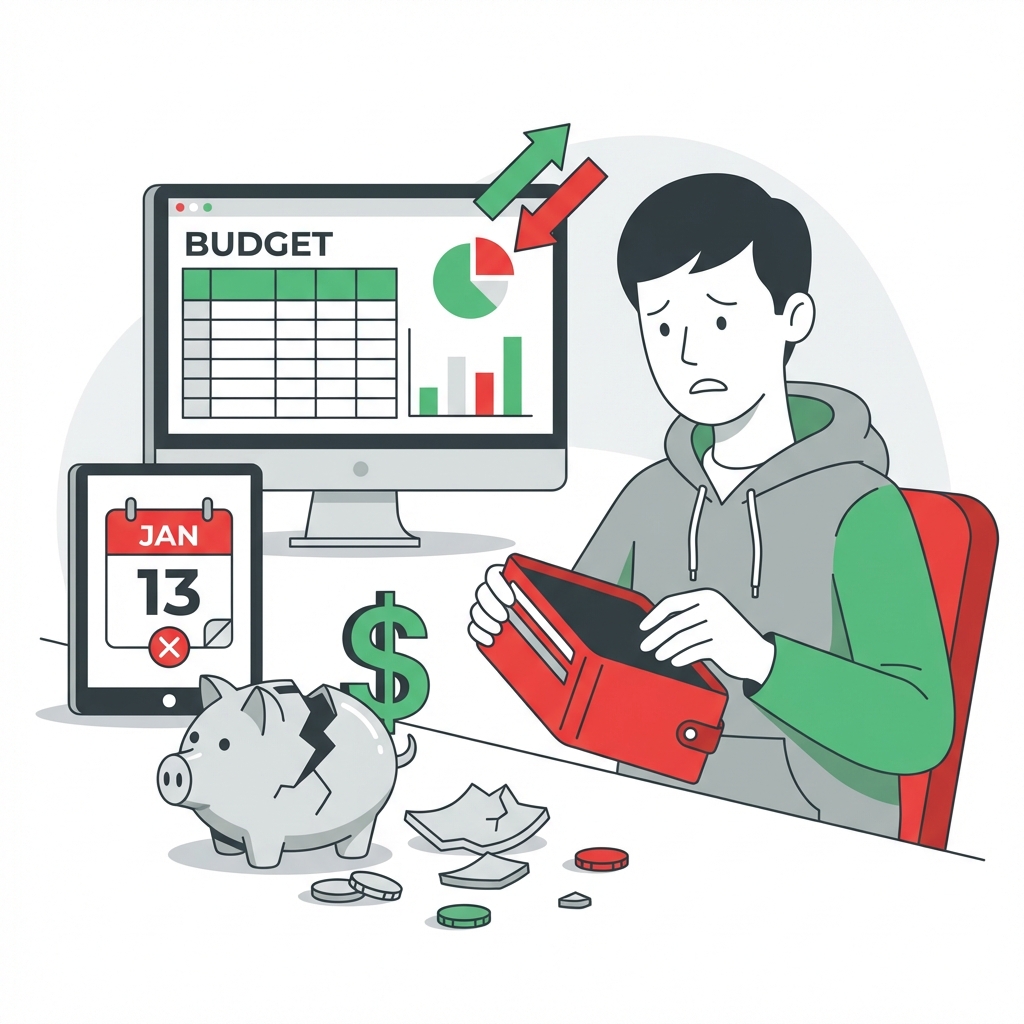
It is January 14th. You entered this new year with a profound, aggressive commitment to financial responsibility. You downloaded a budgeting app, severely lectured yourself about past spending habits, and swore that 2026 would finally be the year you built significant savings.
Yet, here we are, just two weeks into the year. You check your banking app and experience that familiar, sinking feeling in your chest. The account balance is dramatically lower than it should be. The credit card has somehow accumulated a suspicious amount of new charges.
The grand financial reset has already derailed, and you are staring down the exact same anxiety that plagued you in 2025.
You are likely blaming yourself right now. You are assuming you lack discipline or are simply “bad with money.” I want to immediately stop you from doing that.
The rapid failure of January budgets is almost never a personal moral flaw; it is a structural failure. You are relying on brute-force willpower to fight against a highly optimized, trillion-dollar consumer economy specifically designed to extract your money when you are too exhausted to notice.
If you are already feeling broke in 2026, do not panic and do not give up. This guide breaks down exactly why early-year budgets collapse so spectacularly, exposing the hidden traps you fell into, and provides an immediate, ruthless action plan to fundamentally redesign how you manage cash going forward.
Table of Contents
- Introduction
- What Is The “January Financial Slump”?
- Why Understanding It Is Crucial in 2026
- Step-by-Step Framework: The Mid-January Financial Reset
- Real-Life Example: The Hidden Subscriptions Audit
- Common Mistakes in Early Year Budgeting
- Expert Tips for Immediate Cash Flow
- Frequently Asked Questions (FAQ)
- Final Action Plan
- Strong Conclusion
What Is The “January Financial Slump”?
The January Financial Slump is a highly predictable, systemic cash flow crisis that hits the vast majority of young professionals around the second week of the new year.
It is characterized by a severe mismatch between your stated financial goals (saving aggressively) and your actual bank balance, leading to immediate stress and the abandonment of the year’s budget before it realistically began.
This phenomenon is rarely caused by large, catastrophic purchases. It is almost exclusively driven by a combination of delayed holiday consequences (credit card bills), annual auto-renewals quietly triggering, and the massive psychological whiplash of transitioning from December’s “celebratory spending” mindset to January’s “extreme restriction” mindset. Your brain essentially rebels against the sudden austerity.
Why Understanding It Is Crucial in 2026
The financial landscape of 2026 is unforgiving. Inflation continues to quietly chip away at your purchasing power, and companies have become unimaginably sophisticated at implementing subscription models and frictionless payment systems (like one-click checkout and automated UPI payments).
When you understand the exact mechanics of the January slump, you stop relying on “trying harder.” Trying harder does not work when Apple Pay can extract ₹2,000 from your account via FaceID before you have fully processed the purchasing decision.
Understanding why you failed mid-January forces you to abandon the archaic concept of a restrictive, spreadsheet-based “budget” and adopt modern, automated financial defense systems. It is the critical pivot point where you stop playing defense and start actively engineering your financial environment to protect yourself from algorithmic consumerism.
Step-by-Step Framework: The Mid-January Financial Reset
Forget the budget you designed on January 1st; it is dead. It is time to execute a ruthless, tactical reset of your financial systems.
1. The 48-Hour Spending Freeze
You cannot fix a bleeding wound while you are still running. You must immediately declare a mandatory 48-hour total spending freeze. Absolutely zero discretionary spending. No coffees, no e-commerce browsing, no takeout. This serves to break the neurological loop of mindless swiping and forces you to confront exactly where the money is currently leaking.
2. The Autopsy of the Last 14 Days
Sit down with a strong coffee and download your bank statements from December 25th to today. You must look at the numbers. Categorize every single transaction over the last two weeks highlighting specifically three things: late holiday hangover costs, auto-subscriptions you forgot about, and “fatigue purchases” (deliveries ordered when you were too tired to cook). Identify the exact origin of the failure.
3. The “Ghost Subscription” Purge
January is the month annual subscriptions execute. You are likely paying for apps, premium software, and streaming services you haven’t opened since August. Go into your phone’s subscription settings and your credit card auto-billing pages. Cancel at least three active subscriptions immediately. The fastest way to “make” money is to stop bleeding it entirely unnoticed.
4. Implement the “Friction Architecture”
Your money is leaving your account too easily. You must introduce friction back into purchasing. Disconnect your primary credit card from Amazon and food delivery apps. Delete your saved payment details from Chrome/Safari. Forcing yourself to physically stand up, find your wallet, and manually type in a 16-digit card number consistently stops 80% of impulsive, low-value spending.
5. Abandon the “Restrictive” Budget
A budget that tells you “You can only spend ₹2000 on fun this month” will always fail, exactly like a crash diet. Switch immediately to the “Pay Yourself First” model. On the day your salary hits, automatically transfer 20% to savings/investments. Whatever is left over after fixed costs (rent/bills) is yours to spend entirely guilt-free. Stop micromanaging rupees and focus on automating the big chunks.
6. The 24-Hour Cart Delay Rule
Most online purchases are driven by sudden spikes in dopamine engineered by marketing algorithms rather than actual need. For the rest of the year, institute a non-negotiable rule: any non-essential item must sit in an online shopping cart for exactly 24 hours before checkout. In 90% of cases, the intense desire to purchase entirely vanishes overnight.
7. Consolidate and Attack Holiday Debt
If your January slump is caused by December credit card bills, do not simply pay the minimum. That is a trap that will compound into 2027. Redirect all the money you just saved from the Subscription Purge into an aggressive, focused attack on the highest-interest debt. Treat that specific balance as a financial emergency.
Real-Life Example: The Hidden Subscriptions Audit
Last January, exactly two weeks into the year, I felt the familiar panic. My account was dangerously low, and I hadn’t made any large purchases.
I executed Step 2 (The Autopsy) and discovered a massive, silent leak. Because I had signed up for multiple annual subscriptions the previous January during a “productivity kick,” they all auto-renewed simultaneously in the second week of the new year.
- Premium To-Do App (Never used): ₹4,500
- A specialized meditation app: ₹3,000
- A web-hosting plan for an abandoned blog: ₹6,000
- Two forgotten Patreon subscriptions: ₹1,500
I was actively bleeding ₹15,000 in January without a single physical item to show for it.
I immediately executed a purge, set calendar reminders to cancel standard monthly streaming services, and removed my card from Apple Pay. By simply closing the leaks, I effectively gave myself a ₹15,000 raise without taking on a single extra hour of work. The budget stabilized immediately.
Common Mistakes in Early Year Budgeting
When attempting to fix the January slump, avoid these highly destructive tactical errors:
- The “Punishment Diet”: Reacting to mid-January debt by declaring you will eat nothing but plain rice and beans for three weeks. This massive restriction guarantees a catastrophic binge on delivery food by Friday. Make moderate, sustainable cuts, not punitive ones.
- Trusting Mental Accounting: “I think I have around ₹15,000 left for the month.” Your brain is terrible at tracking cumulative small purchases. You must use a banking app or a spreadsheet to track hard numbers; mental accounting always leads to overdrafts.
- The “Sunk Cost” Justification: Keeping an expensive gym membership you never use because you “already paid the joining fee” or hoping you will magically become a gym person in February. Cancel it. Cut the loss immediately and stop the recurring drain. * Ignoring the Latte Factor (And Ignoring the Rent Factor): Obsessing over a ₹150 daily coffee while ignoring that your rent consumes 50% of your income. Yes, cut unnecessary small expenses, but focus your heavy analytical energy on reducing massive fixed overheads (housing or cars).
- Shaming Yourself: Guilt is a profoundly useless financial emotion. It usually leads to “avoidance behavior” where you actively refuse to log into your bank account out of fear. Replace guilt entirely with clinical, cold curiosity about your data.
Expert Tips for Immediate Cash Flow
If you are currently facing a cash crunch right now, use these professional strategies to immediate generate runway:
Liquidate the “Asset Graveyard”
Look in your closet and your tech drawer. That old iPhone, the designer jacket you wore twice, the PlayStation you haven’t turned on in six months—these are highly liquid assets currently depreciating to zero. Spend this Sunday aggressively listing them on online marketplaces. You can easily generate ₹10,000 – ₹20,000 in immediate, tax-free cash within 48 hours to bridge the January gap.
Institute “Zero-Spend” Weekends
Dining out and weekend entertainment absolutely decimate budgets. Challenge yourself to a completely “Zero-Spend Weekend.” Cook entirely from the pantry, go for a hike, visit free municipal museums, or host a potluck where everyone brings an ingredient. Two zero-spend weekends a month alter your financial trajectory massively.
Negotiate Recurring Bills
Do not accept your internet, phone, or car insurance bills as permanent fixed laws of nature. Spend one hour calling customer retention lines. State clearly that you are considering switching to a competitor due to cost. In a significant number of cases, they will immediately offer a 10-15% “loyalty discount” to keep your account active.
Adopt the “Cash Diet” for Groceries
If you consistently overspend at the supermarket, leave your cards at home. Calculate your exact weekly grocery budget (e.g., ₹2000), physically withdraw that cash from an ATM, and walk into the store. When the cash is gone, you are done shopping. It is the single most effective psychological trick for enforcing a hard budget limit.
Frequently Asked Questions (FAQ)
1. Is it too late to set financial goals for 2026? Absolutely not. The calendar year is an arbitrary corporate construct. You can declare your “financial new year” on February 1st, or a random Tuesday in March. The best time to start managing your money was five years ago; the second best time is today at 3:00 PM.
2. Should I dip into my emergency fund to cover January credit card bills? Unless the credit card debt was generated by an actual emergency (medical bill, car repair), do not touch the emergency fund. Draining your safety net to pay for holiday gifts or expensive dinners leaves you dangerously exposed to real crises. Aggressively cut February expenses to pay down the debt instead.
3. What is the biggest hidden drain on a young professional’s income? Convenience. The “Fatigue Tax.” Paying a premium for pre-chopped vegetables, 10-minute grocery delivery, and daily Uber rides because you are too exhausted to cook or take the metro. Organizing your week to ensure you have the energy to do fundamental tasks yourself is the ultimate financial hack.
4. How do I stop impulse buying on my phone late at night? Late-night scrolling is when your willpower is at absolute zero. Delete shopping apps entirely; force yourself to use the clunky mobile browser if you must browse. More importantly, utilize your phone’s screen time limits to explicitly block Amazon, Myntra, or food apps after 9:00 PM.
5. How much of my salary should I actually be saving? While the traditional rule is 20%, in the high-inflation environment of 2026, you should actively push toward aggressively saving/investing 30% if your housing costs allow it. If you are starting from zero, simply automate a 5% transfer today. The priority is establishing the habit of automation, not hitting the massive percentage immediately.
Final Action Plan
If you want to permanently exit the January slump and actually change your financial trajectory, close this article and execute these steps instantly:
- Tonight: Log into your bank account. Do not avoid it. Look at the exact, terrifying number. You cannot fix an enemy you refuse to look at.
- Tomorrow Morning: Cancel three recurring subscriptions. If you hesitate, cancel it. You can always re-subscribe later if you genuinely miss it (you won’t).
- This Weekend: Execute the 48-Hour Spending Freeze. Spend the weekend eating the food currently resting in your pantry and freezer.
- Monday: Log into your payroll or banking portal and automate a transfer to your savings account on the exact day your next paycheck hits. Even if it is only ₹1000.
- The Goal: Stop trying to completely overhaul your personality. Focus entirely on automating your savings and creating intense friction for your spending.
Strong Conclusion
Failing your financial resolutions two weeks into January does not mean you are destined to be broke for the remainder of 2026. It simply means your initial strategy relied entirely on motivation, which is the most fragile, unreliable mechanism in the human brain.
The financial systems designed by corporations in 2026 are predatory, frictionless, and highly optimized to separate you from your cash. You cannot fight an optimized algorithm with a sticky note and a vague promise to “spend less.”
You must fight architecture with architecture. You take back control by deleting apps, removing saved cards, declaring war on silent subscriptions, and aggressively automating your savings so the money is historically gone before you even possess the opportunity to spend it.
Take a deep breath. Forgive yourself for the December holiday spending and the early January failures. Execute the autopsy, cancel the dead weight, and build a system that protects you from yourself. Your definitive financial year starts right now.