Introduction
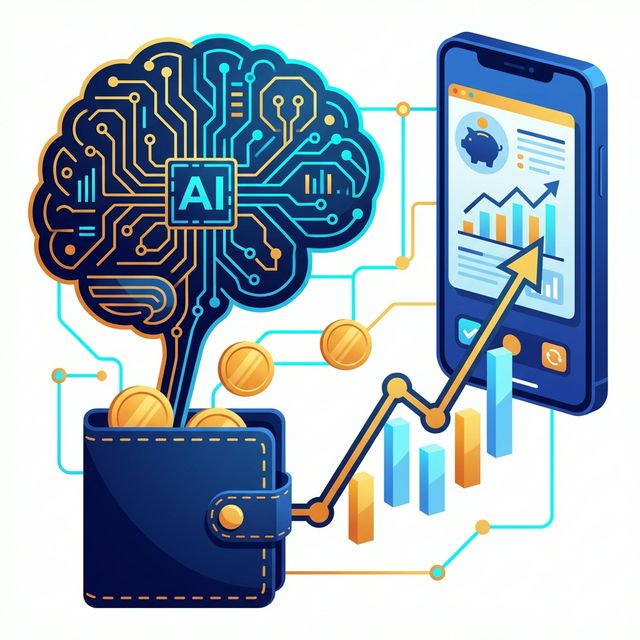
If you used any financial app on your phone in the last 24 hours—checked your bank balance, transferred money via UPI, or reviewed your mutual fund portfolio—artificial intelligence was silently working behind every single interaction.
You probably did not notice. That is entirely by design.
The most profound financial revolution of 2026 is not happening in dramatic, public-facing announcements. It is not a flashy new cryptocurrency or a headline-grabbing fintech IPO. It is happening in the invisible algorithmic layer between you and your money. AI systems are now making real-time decisions about your credit eligibility, your insurance premium, your investment allocation, and even whether your specific transaction is flagged as fraudulent—all within milliseconds, without any human ever reviewing the decision.
For the average consumer, this creates a deeply uncomfortable paradox. AI is making your financial life faster, cheaper, and more convenient than ever before. Simultaneously, it is making financial decisions about your life using criteria you cannot see, cannot understand, and cannot appeal.
This guide breaks down exactly how AI is embedded in personal finance in 2026, where it genuinely helps you, where it quietly exploits you, and the specific strategies you must adopt to ensure these invisible algorithms work for your benefit rather than against it.
Table of Contents
- Introduction
- What Is AI in Personal Finance?
- Why Understanding It Is Critical in 2026
- Step-by-Step Framework: Where AI Touches Your Money
- Real-Life Example: The Robo-Advisor Experiment
- Common Pitfalls of AI-Driven Finance
- Expert Tips for Leveraging AI Safely
- Frequently Asked Questions (FAQ)
- Final Action Plan
- Strong Conclusion
What Is AI in Personal Finance?
Artificial Intelligence in personal finance refers to machine learning algorithms and automated decision-making systems embedded within the financial products and services you use daily. These systems analyze vast datasets—your transaction history, spending patterns, credit behavior, demographic data, and even your phone usage patterns—to make predictions about your financial behavior.
There are two distinct categories of financial AI you interact with:
Consumer-Facing AI: These are the tools explicitly marketed to you. Robo-advisors that manage your investment portfolio automatically. Budgeting apps that categorize your spending and predict your cash flow. Chatbots that handle your banking queries. These are visible, and you consciously choose to use them.
Infrastructure AI: These are the invisible systems operating behind the scenes. Credit scoring algorithms that determine your loan eligibility. Fraud detection models that freeze your card during unusual transactions. Insurance pricing algorithms that calculate your premium based on hundreds of data points you never provided directly. These systems are invisible, and you have no choice but to interact with them.
Why Understanding It Is Critical in 2026
In 2026, the penetration of AI into Indian personal finance has reached a tipping point. Every major bank, lending platform, insurance company, and investment app is now powered by algorithmic decision-making.
This matters because AI systems are not neutral. They are optimized for specific outcomes—usually the profitability of the institution deploying them. A credit scoring AI is not optimized to give you the fairest possible rate; it is optimized to predict your default probability and price your loan to maximize the lender’s risk-adjusted return.
Understanding how these systems work transforms you from a passive data point being processed by algorithms into an informed consumer who can actively optimize their behavior to produce better algorithmic outcomes. When you understand that the AI analyzes your credit utilization ratio, you keep it below 30%. When you understand that insurance AI penalizes late-night driving, you adjust your habits.
Step-by-Step Framework: Where AI Touches Your Money
Here is a systematic breakdown of every major touchpoint where AI algorithms are actively influencing your financial life in 2026.
1. Credit Scoring and Lending
Traditional credit scoring relied on a handful of data points: payment history, outstanding debt, and credit age. In 2026, AI-powered “alternative credit scoring” analyzes hundreds of additional signals: your UPI transaction frequency, your utility bill payment consistency, your phone model, and even the time of day you apply for a loan. These algorithms approve or deny credit applications in under 30 seconds with zero human review.
2. Investment Management (Robo-Advisors)
Platforms like Zerodha’s Coin, Groww, and Kuvera now offer AI-driven portfolio management. You answer a questionnaire about your risk tolerance, investment horizon, and financial goals. The algorithm constructs a diversified portfolio of index funds and ETFs, automatically rebalances it quarterly, and harvests tax losses. The management fee is typically 0.25% to 0.50%, compared to 1% to 2% charged by human financial advisors.
3. Fraud Detection
Every time you swipe your credit card or execute a UPI transaction, an AI model evaluates the transaction against your historical behavioral profile in real time. If the transaction deviates significantly from your established pattern (e.g., a ₹50,000 purchase at 3 AM from a foreign IP address), the model freezes the transaction and sends you an alert within seconds.
4. Insurance Pricing (Telematics and Behavioral Data)
Insurance companies now use AI to dynamically price your premiums based on real-time behavioral data. Auto insurers use telematics apps to track your driving speed, braking patterns, and nighttime driving frequency. Health insurers analyze wearable device data (steps, heart rate, sleep quality). Your premium is no longer based solely on your demographics; it is based on your algorithmic behavioral risk profile.
5. Budgeting and Cash Flow Prediction
Modern budgeting apps like CRED, Fi Money, and Jupiter use AI to automatically categorize every transaction, predict your recurring expenses, forecast your month-end balance, and alert you before potential overdrafts. Some apps even negotiate lower bills or identify subscription services you have forgotten about.
6. Personalized Financial Product Marketing
The recommendations you see for credit cards, loans, and insurance policies are not random. AI algorithms analyze your financial profile and serve you highly targeted product offers optimized for maximum conversion. The “pre-approved” loan offer in your banking app is an algorithmic calculation that you are likely to accept and likely to repay profitably.
Real-Life Example: The Robo-Advisor Experiment
In early 2025, I decided to run a personal experiment. I split ₹3,00,000 of investable capital into two equal portfolios. ₹1,50,000 was allocated to a leading robo-advisor platform with fully automated AI management. ₹1,50,000 was allocated to a portfolio I manually selected using my own research and a traditional financial advisor’s input.
After 12 months, the results were instructive. The robo-advisor returned 14.2%, slightly outperforming the benchmark index. My manually managed portfolio returned 11.8%. The robo-advisor won—but the reasons were not what I expected.
The AI’s advantage was not in stock picking or market timing. It was in behavioral discipline. The algorithm automatically rebalanced the portfolio during two significant market corrections, systematically buying low when my human instinct was screaming to sell everything. It harvested small tax losses I would have never identified. And it charged 0.35% in fees versus the 1.5% my human advisor charged.
The AI did not beat me with intelligence. It beat me by removing my emotions from the equation and by being cheaper.
Common Pitfalls of AI-Driven Finance
While AI offers genuine benefits, be acutely aware of these significant risks:
- The “Black Box” Problem: AI credit scoring and insurance pricing models are proprietary. You cannot see the exact criteria used to deny your loan or inflate your premium. This lack of transparency makes it extremely difficult to identify and challenge discriminatory or erroneous algorithmic decisions.
- Data Privacy Erosion: The more financial data you share with AI-powered apps, the more precisely they can profile and target you. Your spending data, investment patterns, and location history are enormously valuable to advertisers. Read the privacy policy before granting any financial app access to your contacts, messages, or location.
- Over-Reliance on Automation: Setting up a robo-advisor and never reviewing it again for five years is dangerous. AI models are trained on historical data. If market conditions fundamentally shift (a hyperinflationary event, a regulatory change), the historical patterns the model relies on may become invalid. Review automated portfolios at least quarterly.
- Algorithmic Bias: AI models are trained on historical human lending data, which contains deep systemic biases against certain demographics, geographic locations, and income profiles. An AI trained on biased historical data will perpetuate and amplify those biases, potentially denying credit to qualified applicants based on factors correlated with protected characteristics.
- The “Personalized Offer” Trap: When an app shows you a “personalized” loan or credit card offer, the algorithm has calculated that this specific product is highly profitable for them at your specific risk profile. A “personalized” offer is not necessarily the best offer available to you on the open market.
Expert Tips for Leveraging AI Safely
To harness the benefits of financial AI while protecting yourself from its risks, implement these strategies:
Treat AI as a Co-Pilot, Not an Autopilot
Use robo-advisors and budgeting apps as powerful analytical tools, but maintain final decision-making authority on major financial moves. Let the AI suggest and automate routine tasks (rebalancing, categorization), but human judgment should govern large purchases, career-linked investments, and major life-stage financial decisions.
Actively Manage Your “Algorithmic Reputation”
Your credit score is an algorithmic output. Actively optimize the inputs. Keep credit utilization below 30%, never miss a payment deadline (even by a day), maintain old credit accounts for length-of-history signals, and avoid applying for multiple credit products within a short window (each application triggers a “hard inquiry” that temporarily lowers your score).
Diversify Your Data Exposure
Do not concentrate all your financial data within a single app ecosystem. If one platform holds your banking, investing, insurance, and lending data, they possess an extraordinarily comprehensive profile of your financial life. Distribute across multiple platforms to limit any single entity’s data leverage over you.
Frequently Asked Questions (FAQ)
1. Will AI financial advisors replace human financial advisors entirely? For standard portfolio management (index fund allocation, rebalancing, tax harvesting), AI already outperforms the average human advisor at a fraction of the cost. However, for complex financial planning (estate planning, business succession, tax strategy for high-net-worth individuals), human advisors remain indispensable due to the nuanced, qualitative judgment required.
2. Can AI predict stock market movements? No. Despite enormous investment in predictive models, no AI system has demonstrated consistent, reliable ability to predict short-term market movements. AI excels at risk management, portfolio optimization, and behavioral pattern recognition, not at market timing or stock picking.
3. Is it safe to let an app access my bank account data? Only if the app uses secure, API-based data aggregation (like Account Aggregator framework in India) rather than requiring your login credentials. Never share your banking password or PIN with any third-party app. Legitimate fintech platforms use tokenized, read-only access that cannot initiate transactions.
4. How do I know if an AI algorithm is being unfair to me? If you are denied credit or given an unexpectedly high insurance premium, you have the right to request an explanation. In India, the RBI mandates that lenders provide a reason for loan rejection. Compare the terms offered to you against publicly available market rates. If there is a significant, unexplainable discrepancy, file a formal grievance.
5. Should I trust AI-generated financial advice from chatbots? AI chatbots can provide accurate general financial information (explaining tax sections, calculating EMIs, defining terms). However, they should never be trusted for personalized financial advice that considers your complete life situation. Treat chatbot responses as educational starting points, not actionable financial plans.
Final Action Plan
To position yourself optimally within the AI-driven financial ecosystem of 2026, take these immediate actions:
- Today: Review the permissions granted to every financial app on your phone. Revoke access to contacts, messages, or location data unless absolutely necessary for core functionality.
- This Week: Check your credit score on a free platform. Identify the specific factors suppressing your score and create a 90-day plan to optimize them.
- This Month: Compare the fee structure of your current investment management against a leading robo-advisor. If you are paying more than 0.5% in management fees for basic index fund allocation, consider switching.
- Ongoing: Review any automated investment portfolio at least once per quarter. Verify that the AI’s allocation still aligns with your current risk tolerance and life stage.
- The Core Principle: Embrace AI as a tool for efficiency and discipline, but never surrender complete financial autonomy to an algorithm you cannot inspect or override.
Strong Conclusion
Artificial Intelligence in personal finance is not a future possibility. It is the current, operational reality governing your credit access, investment returns, insurance costs, and financial security in 2026.
The professionals who thrive in this environment are not those who fear AI or blindly trust it. They are the ones who understand exactly where the algorithms are operating, what data is feeding them, and how to optimize their behavior to produce favorable algorithmic outcomes.
AI removes emotion from investing, which is genuinely powerful. It detects fraud in milliseconds, which is genuinely protective. But it also prices your insurance based on data you did not knowingly provide, and it decides your creditworthiness using criteria you cannot see.
Your responsibility as a modern financial consumer is to leverage the efficiency of AI while fiercely maintaining your informational awareness and decision-making sovereignty. Let the algorithms handle the routine math. Keep the strategic thinking firmly in human hands.