Introduction
If someone asked you to explain exactly how your health insurance policy works—right now, from memory—could you do it? Could you explain the precise difference between a deductible and a copay? Could you state your exact out-of-pocket maximum or articulate when your coverage actually begins paying?
If you are like the overwhelming majority of adults in 2026, the honest answer is no. You pay a significant monthly premium, you vaguely trust that you are “covered,” and you actively avoid reading the dense, hostile policy documents sitting in your email because they feel deliberately designed to be incomprehensible.
This is not an accident. The insurance industry has spent over a century deliberately engineering complexity. The more confused you are, the less likely you are to challenge a denied claim, negotiate a lower premium, or realize you are paying for coverage you fundamentally do not need.
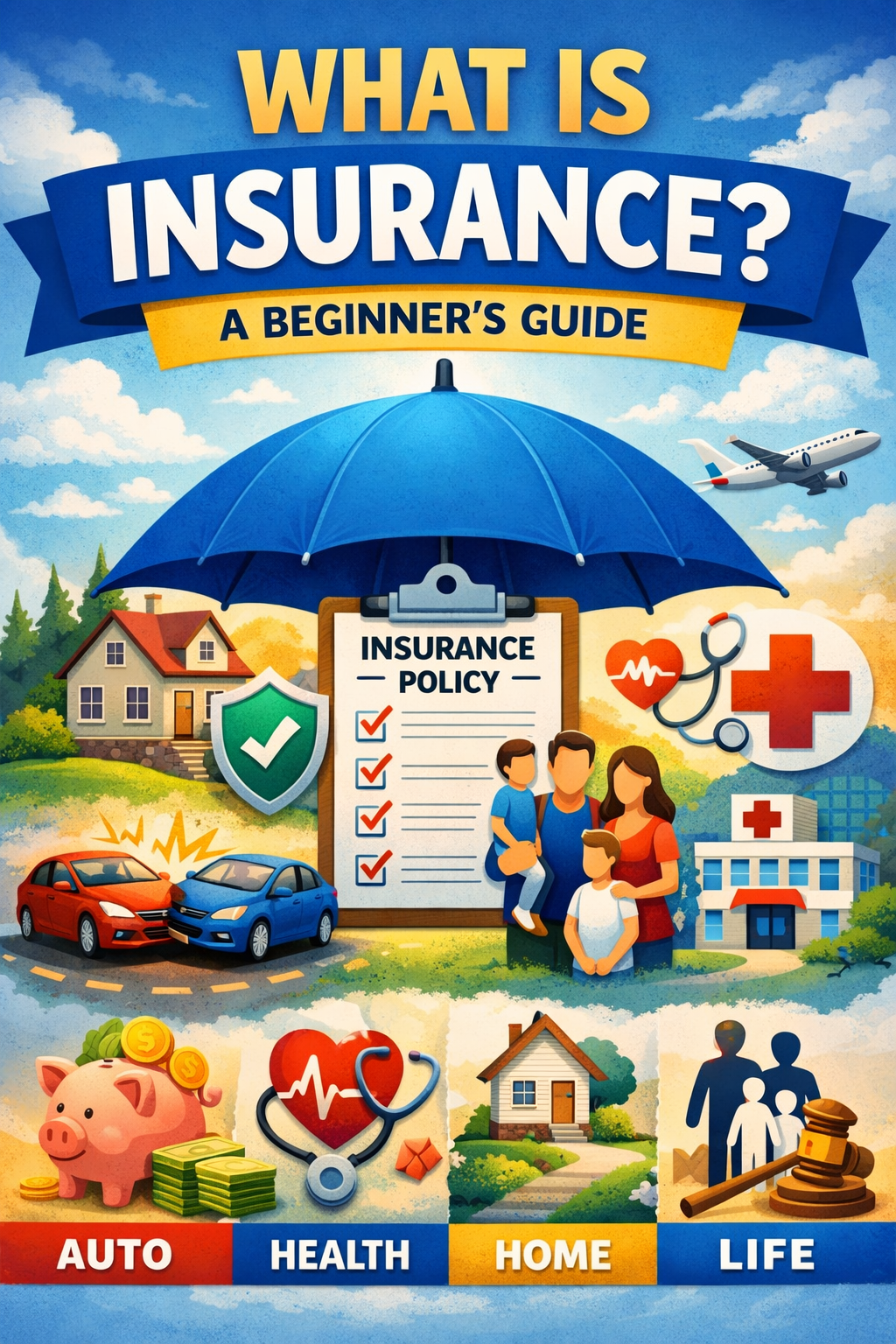
Insurance is not a mysterious financial luxury. At its absolute core, it is profoundly simple mathematics. It is a system where thousands of people pool small amounts of money together so that the few individuals who experience a catastrophic, statistically unlikely event do not face complete financial annihilation.
If you have ever felt intimidated, confused, or simply bored by the concept of insurance, this guide is built specifically for you. We are going to strip away every single layer of corporate jargon and explain exactly how the machinery works, why it exists, what you actually need, and what the industry is aggressively trying to sell you that you absolutely do not.
Table of Contents
- Introduction
- What Is Insurance, Really?
- Why Understanding It Matters in 2026
- Step-by-Step Framework: How Insurance Actually Functions
- Real-Life Example: The Apartment Fire
- Common Mistakes Beginners Make
- Expert Tips for Your First Policy
- Frequently Asked Questions (FAQ)
- Final Action Plan
- Strong Conclusion
What Is Insurance, Really?
Imagine you live in a village of 1,000 families. Every year, statistically, one house in the village will burn down. Rebuilding that house costs ₹20,00,000. No single family can absorb that cost overnight.
So the village creates a simple agreement: every family contributes ₹2,000 per year into a shared community fund. That fund collects ₹20,00,000 annually. When the one unlucky family’s house burns down, the fund pays for the entire rebuild. The remaining 999 families lost a small, manageable ₹2,000 each but gained the permanent guarantee that if disaster strikes them next year, they are fully protected.
That is insurance. That is the entire concept. Everything else—the dense paperwork, the complex riders, the aggressive agents—is simply layers of corporate infrastructure built on top of this profoundly simple village agreement.
Your “premium” is the ₹2,000 annual contribution. The “insurer” is the entity managing the community fund. And a “claim” is the unlucky family requesting the fund to pay for their rebuild.
Why Understanding It Matters in 2026
In 2026, the average young professional interacts with insurance across almost every dimension of their financial life: health insurance through their employer, auto insurance mandated by law, renter’s or homeowner’s insurance protecting their assets, and potentially life insurance protecting their dependents.
Yet financial literacy surveys consistently reveal that the majority of adults cannot correctly define basic insurance terms. This knowledge gap is enormously expensive. When you do not understand your policy, you overpay on premiums for coverage you do not need, you under-insure against catastrophic risks that could bankrupt you, and you fail to file legitimate claims because you do not realize the event was covered.
The insurance industry in 2026 collects trillions of rupees globally. A significant portion of that revenue comes directly from consumer confusion and apathy. Understanding the basic mechanics is not optional financial literacy—it is a fundamental defensive skill against one of the largest industries on the planet.
Step-by-Step Framework: How Insurance Actually Functions
Every single insurance product on earth—health, auto, life, home, travel—operates on the exact same mechanical framework. Once you understand these five components, you can decode any policy.
1. The Premium (Your Subscription Fee)
This is the fixed, recurring amount you pay simply to keep the contract active. Think of it as a Netflix subscription for financial protection. Whether you use the service or not, you pay the premium. If you stop paying, the contract immediately dies, and you lose all protection.
2. The Deductible (Your Financial Skin in the Game)
This is the amount of money you must pay entirely out of your own pocket before the insurance company contributes a single rupee. If your health insurance has a ₹50,000 deductible and you have a ₹40,000 hospital bill, the insurer pays exactly nothing. You must reach the ₹50,000 threshold first. Higher deductibles mean lower premiums, and vice versa.
3. The Coverage Limit (The Maximum Payout)
Every policy has a ceiling. If your auto policy has a coverage limit of ₹10,00,000 and you cause an accident costing ₹15,00,000, the insurer pays ₹10,00,000 and you are personally liable for the remaining ₹5,00,000. Always check the ceiling.
4. The Claim (Your Request for Payment)
When the insured event occurs (accident, illness, fire), you submit formal documentation to the insurer requesting them to pay. The insurer then investigates, validates, and either approves the full payment, offers a partial payment, or denies the claim entirely based on the policy terms.
5. The Exclusions (What They Will Never Pay For)
Every policy contains a list of specific scenarios they explicitly refuse to cover. Flood damage is often excluded from standard home policies. Cosmetic surgery is excluded from health policies. Pre-existing conditions may have waiting periods. The exclusions section is the single most important part of any policy document, and it is the section most consumers never read.
Real-Life Example: The Apartment Fire
My colleague Anika rented a beautiful apartment in South Delhi. She assumed her landlord’s building insurance covered her personal belongings inside the apartment. She never purchased renter’s insurance because she considered it an unnecessary expense for a 26-year-old.
A kitchen fire broke out due to an electrical short circuit. The landlord’s insurance covered the structural repairs to the building walls and ceiling. However, the landlord’s policy explicitly excluded tenant belongings.
Anika lost her laptop (₹1,20,000), her wardrobe (₹80,000), important documents, and personal electronics totaling approximately ₹3,50,000. She had zero coverage and zero recourse. A basic renter’s insurance policy covering ₹5,00,000 of personal property would have cost her approximately ₹250 per month. She lost ₹3,50,000 to save ₹3,000 per year.
This is the brutal mathematics of being uninsured or underinsured. Insurance exists to protect against precisely these low-probability, high-severity events.
Common Mistakes Beginners Make
When purchasing your first insurance policies, guard aggressively against these highly prevalent errors:
- Buying Based on Premium Alone: Selecting the cheapest policy guarantees the highest deductibles, the lowest coverage limits, and the most aggressive exclusions. The cheapest policy is almost always the most expensive one when you actually need to use it.
- Assuming Everything Is Covered: Reading the marketing brochure and assuming you understand the policy. You must read the “Exclusions” and “Limitations” sections of the actual policy document. If flood damage, mental health, or specific pre-existing conditions are excluded, you need to know before the event, not after.
- Ignoring the “Waiting Period”: Many health policies refuse to cover pre-existing conditions for the first 2 to 4 years. If you buy a policy in January and try to claim for a chronic condition diagnosed in March, the claim will be legally denied.
- Relying Solely on Employer Coverage: Corporate insurance is a tremendous benefit, but it vanishes the instant you leave the company. If you develop a serious health condition while employed and then get laid off, you may become uninsurable on the private market. Always maintain at least one independent policy.
- Not Declaring Truthfully: Lying on your application about smoking, pre-existing conditions, or driving history is called “material misrepresentation.” If the insurer discovers the lie during a claim investigation, they can legally void the entire policy retroactively and refuse to pay anything, even if you paid premiums for years.
Expert Tips for Your First Policy
If you are purchasing insurance for the first time, use these professional strategies to maximize your protection:
Start With the Catastrophic Shield
Your first insurance purchase should always cover the single event most likely to cause total financial ruin. For most young professionals, this is a major health emergency. A ₹10,00,000 health policy is the absolute minimum baseline in 2026 given the astronomical cost of hospitalization. Buy this before anything else.
Understand the “Indemnity” vs. “Benefit” Distinction
An “Indemnity” policy reimburses you for the actual cost incurred (e.g., your hospital bill was ₹2,00,000, so they pay ₹2,00,000). A “Benefit” policy pays a fixed, pre-agreed lump sum regardless of actual cost (e.g., ₹5,00,000 if diagnosed with cancer, even if treatment costs ₹1,00,000). Both are valid; understand which type you hold.
Never Skip the “Free Look” Period
In India, IRDAI mandates a 15-day “Free Look” period after purchasing any new policy. During this window, you can read the full policy document carefully, and if anything is unacceptable, you can return the policy for a complete refund of the premium. Treat this like a mandatory return window.
Bundle Intelligently
Insurance companies offer significant discounts when you purchase multiple policies from the same provider. Bundling your health, auto, and home insurance with one company can save 10% to 15% annually while simplifying your claims process through a single point of contact.
Frequently Asked Questions (FAQ)
1. Do I need insurance if I am young and healthy? Absolutely yes. Insurance is cheapest when you are young and healthy because the insurer considers you low-risk. If you wait until you develop a condition, the premiums skyrocket or coverage may be denied entirely. Buy early, lock in cheap rates, and treat it as a permanent financial utility.
2. What is the difference between “first-party” and “third-party” insurance? First-party insurance covers damage to your own property or body. Third-party insurance covers damage you cause to someone else’s property or body. In auto insurance, third-party liability is legally mandatory in most countries; first-party (comprehensive) coverage is optional but highly recommended.
3. Can the insurance company refuse to pay my claim? Yes, legally. If the event falls under the policy’s exclusions, if you failed to disclose a material fact during application, if the claim is filed after the deadline, or if fraud is suspected, the insurer can deny the claim. This is why reading the exclusions section before purchasing is non-negotiable.
4. What is a “rider” or “add-on”? A rider is an optional, additional coverage module you can attach to a base policy for an extra premium. For example, adding a “Critical Illness Rider” to a standard health policy provides a lump-sum payout if you are diagnosed with cancer or heart disease. Some riders are valuable; many are aggressively overpriced.
5. How much insurance is “enough”? The mathematical answer is: enough to prevent total financial ruin from a single catastrophic event. For health insurance, this means covering at least ₹10,00,000 in hospitalization. For life insurance, it means covering 10 to 15 times your annual income. For auto insurance, it means maximizing your third-party liability limits.
Final Action Plan
If you currently have zero independent insurance or you are confused about your existing coverage, execute this protocol immediately:
- Tonight: Find your existing policy documents. Read the “Exclusions” section completely. Identify any gaps.
- Tomorrow: If you lack independent health insurance, generate three quotes online from major providers for a ₹10,00,000 base health policy.
- This Weekend: Calculate your total financial exposure. If your car is uninsured beyond third-party, if your rented apartment’s contents are uninsured, or if your dependents lack life insurance coverage from you, prioritize accordingly.
- The Rule: Always buy insurance for catastrophic, life-altering events first. Do not waste premiums on trivial coverages (like extended warranties on electronics) before your health, income, and major assets are fully shielded.
Strong Conclusion
Insurance is not a complicated, mystical financial product. It is a profoundly simple mathematical agreement: many people pool small amounts of money to protect the few who face catastrophic events.
The complexity that surrounds the industry is deliberately engineered. It exists to confuse you into overpaying, under-claiming, and remaining perpetually dependent on agents who profit from your ignorance.
When you strip away the jargon and understand the five mechanical components—premium, deductible, coverage limit, claim, and exclusions—you immediately reclaim the power to make informed, mathematical decisions about your financial protection.
Stop treating insurance as a confusing obligation you avoid thinking about. Treat it as the most critical piece of defensive financial infrastructure you own. Understand it, optimize it, and ensure it is structurally designed to protect you from the single worst financial day of your life.
1 thought on “What Is Insurance? A Beginner’s Guide”